AI systems and judgement
AI ecosystems, reinforcement learning, engineering and development, model capabilities, governance, safety and quality.
Executive learning / applied AI / commercial operating systems
I bring the unique combination of technical fluency and the operator's judgement to know when AI should improve an outcome, how to measure it and how to make the intervention accountable.
Explore the Applied AI Program ↗
01 / The programme
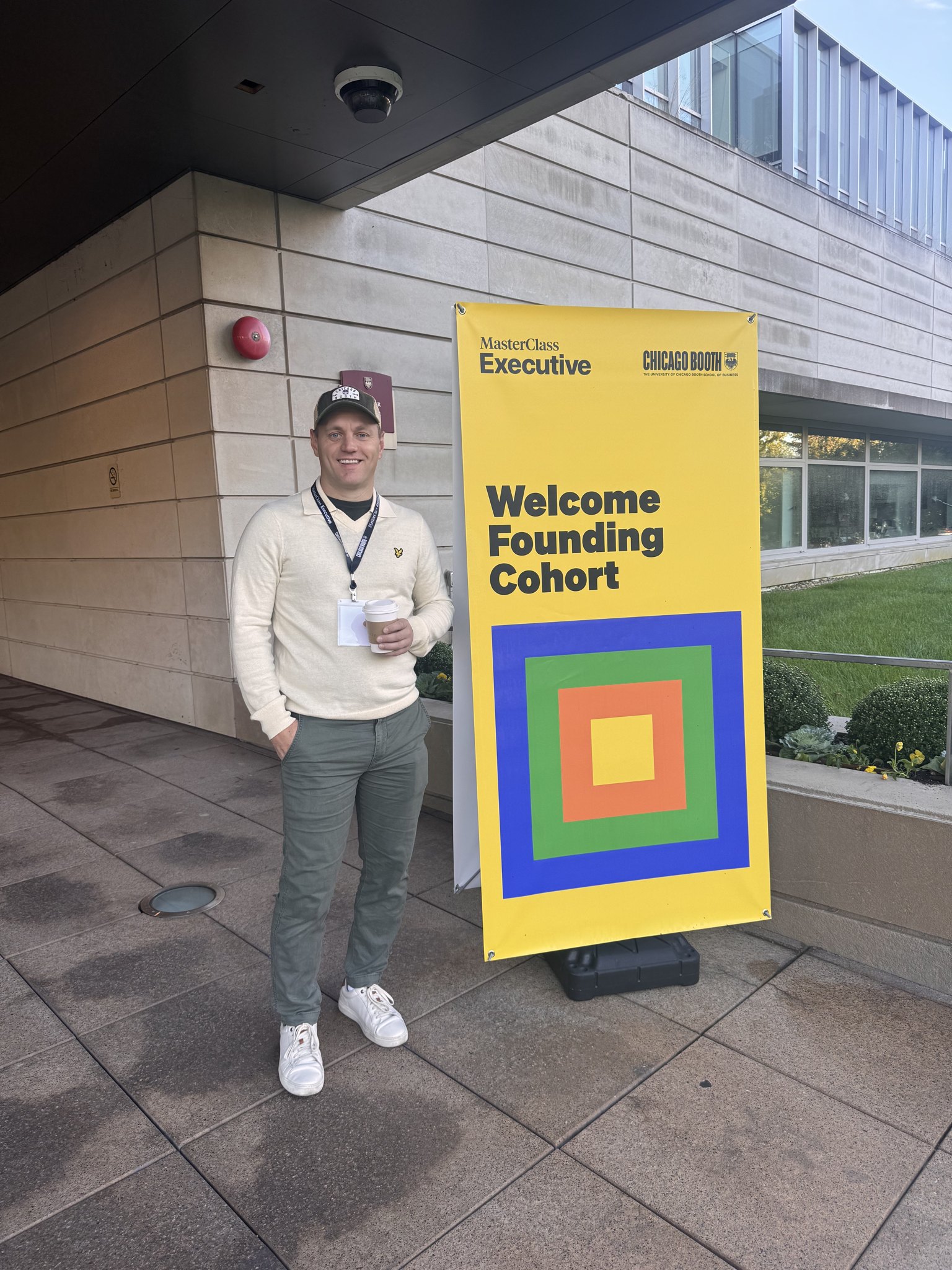
MasterClass Executive is a selective, compressed AI leadership programme with an MBA-style curriculum, created with the University of Chicago Booth School of Business and built in collaboration with OpenAI. Its intensive approach combines business education, adaptive learning, expert-led sessions and hands-on labs.
I am an ambassador member of the founding cohort. The founding cohort comprised 700 members selected from 29,000 applicants.
This is an executive-learning programme, not a Chicago Booth MBA degree or an OpenAI employment credential.
02 / What I am learning and building
AI ecosystems, reinforcement learning, engineering and development, model capabilities, governance, safety and quality.
Financial analysis and modelling, customer research, synthetic use cases, use-case selection and return-on-investment design.
AI prototypes, agentic workflows and proprietary agents for sales and go-to-market execution.
Answer-engine optimisation, customer-support automation, storytelling and slide decks with AI, and learning to work with AI itself.
03 / AI in GTM · the judgement opportunity
THE QUESTION
AI adoption is not the same as commercial return. The test is whether it removes work sellers cannot get to, exposes the evidence that matters and helps a person make a better decision.
The gap is the point: more AI use has not, by itself, produced a comparable shift in time spent selling. These are directional comparisons across separate survey editions, not a causal ROI calculation. Sources: Salesforce State of Sales, 4th edition and 2026 findings.
THE DEFAULT
More output enters the system. The seller still has to reconstruct the account, separate signal from noise and decide what to do.
THE BETTER DIVISION OF LABOUR
AI handles the evidence burden. A human retains the relationship, the intervention and accountability for the decision.
What changed? Which customer behaviour supports it? What evidence is missing?
Review the evidence, choose the intervention and record the reason.
WHAT BREAKS RETURN
Too many alerts recreate noise. A CRM stage is not buyer evidence. A fixed play ignores context. The system must be able to say “not enough evidence.”
A BETTER FIRST TEST
Start with a live or anonymised opportunity. Make each signal inspectable and falsifiable. Let the seller accept, correct or reject it. Measure whether it surfaced something worth acting on before expanding the workflow.
Evidence boundary: the decision workspace above adapts a synthetic prototype. It illustrates a method; it does not claim measured conversion, productivity or revenue gains.
04 / Learning environment
Programme and event learning draws on leaders and organisations working at the frontier of AI products and business adoption.
Clay · Decagon · ElevenLabs · Gamma · GraphAI · OpenAI · Weights & Biases · Micro1
Grant Lee · Mark Cuban · Indra Nooyi · Ray Dalio · Gary Vaynerchuk · Jerry Dischler · Steven Kaplan
05 / The operating test
My starting point is never “Where can we add AI?” It is: which decision, workflow or customer experience is constrained, and what evidence would show an AI intervention has improved it?
That is the combination I bring to a commercial mandate: technical literacy, commercial operating experience and the discipline to separate a promising demonstration from durable value.